Cosmic Radiance: Astronaut Captures Milky Way Amid Earth's Airglow from Space Station
Introduction
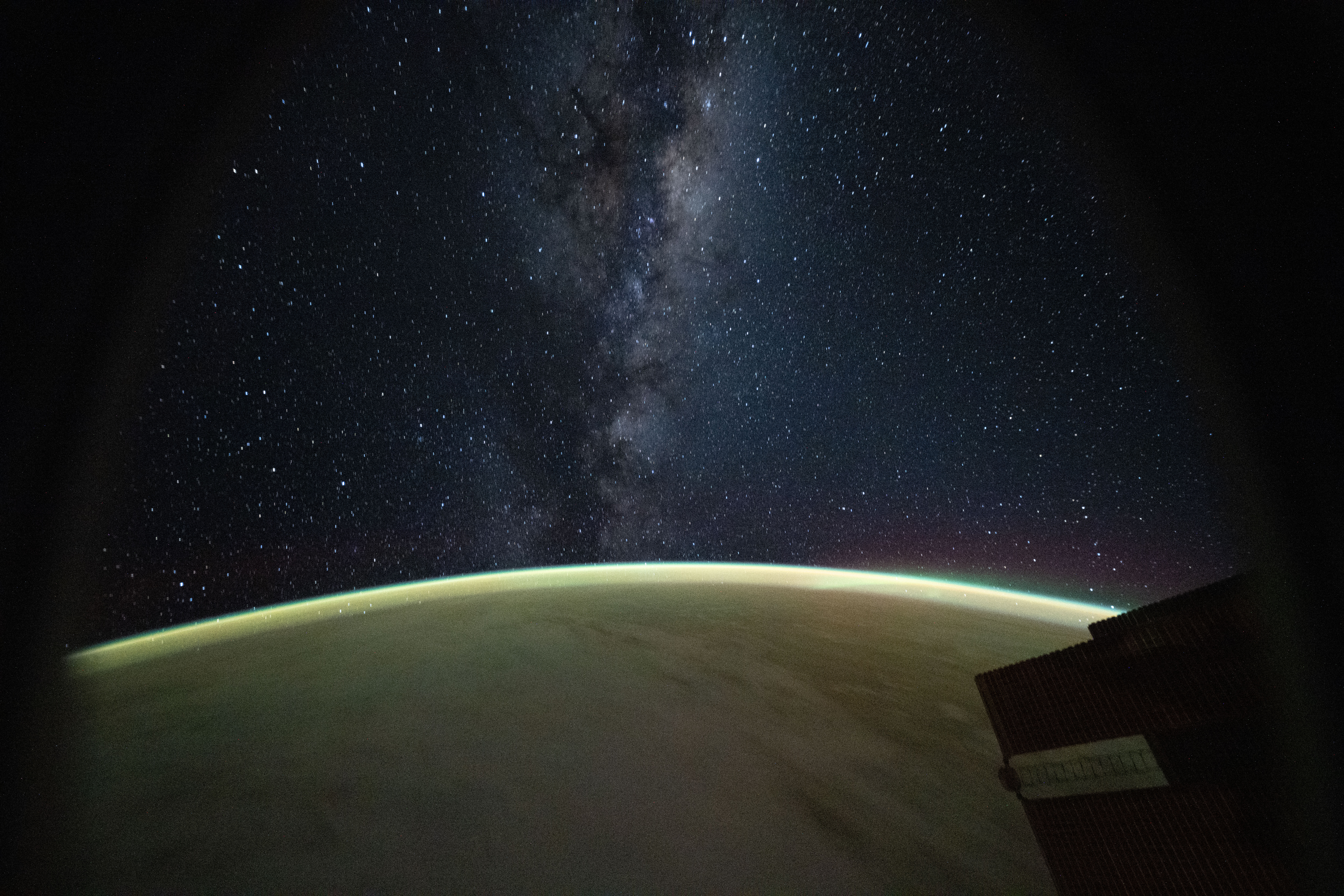
On April 13, 2026, NASA astronaut Chris Williams, stationed aboard a SpaceX Dragon capsule docked to the International Space Station (ISS), captured a breathtaking image of the Milky Way rising above Earth's luminous atmospheric glow. This photograph, titled "Glowing Views from the Space Station," offers a stunning reminder of the delicate interplay between our planet and the cosmos.
What Is Airglow?
The ethereal glow enveloping Earth in the image is called airglow. Unlike the familiar northern or southern lights—auroras—which are driven by high-energy particles from the solar wind colliding with the atmosphere, airglow is a subtler, constant phenomenon. It occurs when atoms and molecules in the upper atmosphere absorb energy from ordinary sunlight and then release that energy as light, or photons. This process can happen in two ways:
- Excited atoms and molecules absorb sunlight and later emit photons to shed excess energy.
- Ionized atoms and molecules that have gained a charge from sunlight collide with free electrons, recombine, and release a photon.
In both cases, the result is a faint, diffuse glow that is always present in the night sky, though it is most visible from space or very dark locations on Earth.
Airglow vs. Aurora: Key Differences
While both airglow and auroras produce beautiful light shows in Earth's atmosphere, their origins are distinct:
- Energy source: Auroras are powered by high-energy particles from the solar wind that funnel down magnetic field lines toward the poles. Airglow, in contrast, is driven by the everyday ultraviolet and visible radiation from the sun.
- Location: Auroras are largely confined to polar regions, whereas airglow can be observed at all latitudes, though it is strongest at mid-latitudes.
- Brightness: Auroras can be dramatically bright and dynamic, while airglow is comparatively dim and steady.
Understanding these differences helps scientists study both the sun's influence on Earth and the chemistry of our atmosphere.
Why Airglow Matters for Science
Airglow is not just a pretty sight; it provides crucial data for atmospheric scientists. By analyzing the spectrum of airglow, researchers can determine the composition and temperature of the upper atmosphere (the mesosphere and lower thermosphere). For example, different wavelengths correspond to specific elements and molecules:
- Oxygen atoms emit green and red light.
- Hydroxyl (OH) molecules emit in the near-infrared.
- Sodium atoms produce a yellowish glow.
This information helps model atmospheric dynamics, study wave propagation, and even monitor changes linked to solar activity. The ISS, with its vantage point, offers a unique platform for continuous airglow observations.
The Role of the ISS and Its Crew
Astronauts aboard the International Space Station frequently document such phenomena. Chris Williams's photograph, taken from a SpaceX Dragon spacecraft, highlights the synergy between human spaceflight and scientific documentation. The ISS's low Earth orbit—about 400 kilometers altitude—places it right in the middle of the airglow layer, providing an unobstructed view of the Milky Way and the glowing horizon.
These images serve multiple purposes: they inspire the public, provide data for educational outreach, and can even be used for calibration of imaging instruments. For instance, the precise timing and location of such photos help ground-based observatories correlate space-based and terrestrial observations.
Tips for Observing Airglow from Earth
While the best viewing is from space, dedicated stargazers on the ground can also spot airglow under ideal conditions:
- Choose a moonless night far from city lights.
- Look at the horizon about 90 minutes after sunset or before sunrise—the glow is most intense at those times.
- Use a long-exposure camera; the human eye may see only a faint hint, but a camera sensor can reveal the colorful bands.
- Point the camera toward the southern or northern horizon (depending on your hemisphere) to capture the thickest atmosphere.
Conclusion
Astronaut Chris Williams's image of the Milky Way and Earth's airglow is more than a striking visual—it is a snapshot of ongoing atmospheric processes that affect our planet's energy balance. By studying airglow, scientists learn about the upper atmosphere's response to solar radiation, which in turn improves climate and space weather models. As humanity continues to live and work in space, such observations will remain invaluable.
For more information about airglow and auroras, see our sections on Airglow vs. Aurora and Scientific Importance.
Image credit: NASA/Chris Williams